What Does Non-Comedogenic Really Mean? The Honest Answer (and How to Check Your Products)
Non-comedogenic has no FDA definition. Here's what the rating scale means, which ingredients to watch for, and how to check any skincare product.
 Opus Team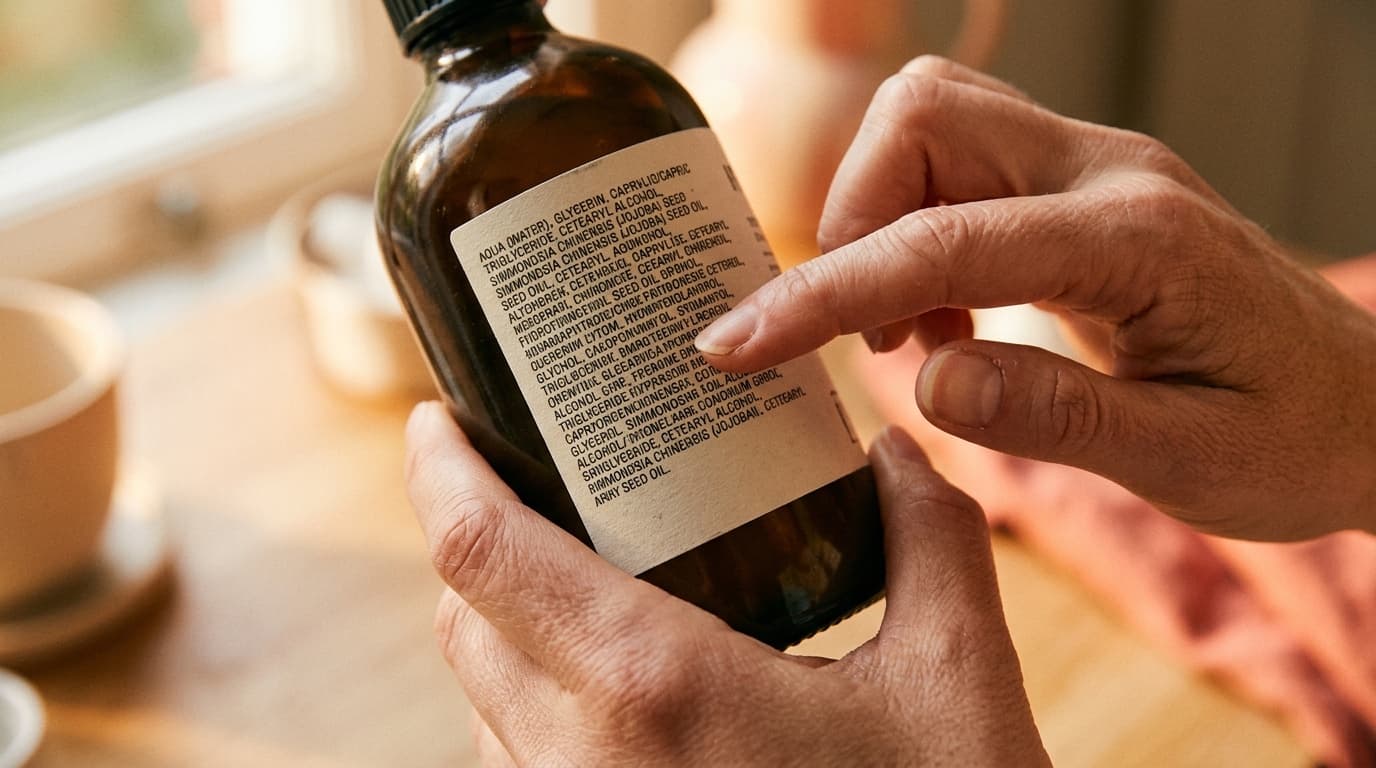
What Does Non-Comedogenic Really Mean? The Honest Answer (and How to Check Your Products)
TL;DR: "Non-comedogenic" on a product label has no legal definition — any brand can print it with zero proof. The 0–5 comedogenic rating scale is a useful red flag, not a verdict: concentration, skin type, and formula context change everything. What actually tells you whether a product may clog your pores is the ingredient list (INCI). Here's how to read it, which ingredients to watch for, and why some "natural" picks are worse offenders than any synthetic.
The Label "Non-Comedogenic" Has No Legal Definition
If you've been scanning labels for that "non-comedogenic" stamp before buying a moisturizer, here's the honest truth: it means exactly as much as a brand decides it means — which is sometimes nothing at all.
The U.S. Food and Drug Administration does not regulate the term "non-comedogenic." No independent testing is required, no approved method exists, and no governing body verifies the claim before a product hits shelves. As CeraVe itself notes on its own website, "non-comedogenic as a term isn't regulated by the FDA, so though it can be a good guideline to look for if you're acne-prone, it's not the end-all, be-all."
The same gap exists in the EU, UK, and Canada. A 2025 review in JAAD Reviews (the Journal of the American Academy of Dermatology) confirmed this explicitly, describing a lack of standardized testing and widespread regulatory gaps that allow brands to freely label products as non-comedogenic regardless of their actual pore-clogging potential.
This doesn't mean the term is useless — a brand that cares about its reputation will try to back it up. But it means you can't rely on the front of the package. You have to look at the back.
The Comedogenic Rating Scale — and Why It's a Red Flag, Not a Verdict
You may have encountered the 0–5 comedogenic rating scale on sites like INCIDecoder or SkinSort. Here's where it came from and what it actually tells you.
In 1989, dermatologist Dr. James Fulton published a landmark paper in the Journal of the Society of Cosmetic Chemists. His team applied hundreds of raw cosmetic ingredients — undiluted, at 100% concentration — to the ears of rabbits, then measured comedone formation. The result: the 0–5 scale that the skincare industry has been citing ever since.
The problem? That was nearly 50 years ago, and the methodology has serious known limitations.
Rabbits aren't human skin. A 1982 study by Kligman and Mills found that some substances that scored as potent comedogens on rabbit ears produced little to no comedone formation in actual human skin. The rabbit model, it turned out, was overly sensitive.
Concentration matters enormously. A landmark follow-up study by dermatologists Draelos and DiNardo tested 100% acetylated lanolin alcohol, which rated 4–5 on the Fulton scale. When diluted to 2.5% — the kind of concentration you'd actually find in a formulated product — the comedogenicity dropped to approximately 1. The same study found that cosmetics containing multiple high-rated ingredients didn't reliably increase microcomedone formation in human subjects.
The JAAD Reviews 2025 paper summarizes the current scientific consensus: substances would need to score consistently higher than 3 on the rabbit assay to indicate meaningful comedogenic risk in humans — and even then, formula context and individual skin type matter.
How to use the scale correctly: treat a rating of 4–5 on a high-listed ingredient as a reason to investigate further, not as proof that a product will break you out. Treat a rating of 0–2 as broadly reassuring. Ratings of 3 are in genuinely uncertain territory.
8 Commonly High-Rated Comedogenic Ingredients (and Where They Hide)
These appear repeatedly in peer-reviewed research and across ingredient databases as consistent high scorers. All carry the caveats above — concentration and formula context still matter — but they're worth knowing on sight.
1. Isopropyl Myristate (INCI: Isopropyl Myristate) — Fulton: 5/5
One of the most documented pore-cloggers in dermatology research. Used as a penetration enhancer and emollient in many drugstore face creams and foundations. If it's in the top five ingredients on the label, it's present at a meaningful concentration.
2. Coconut Oil (INCI: Cocos Nucifera Oil) — Rating: ~4/5
Possibly the most surprising entry for fans of "natural" skincare. Coconut oil's high lauric acid content gives it solid antimicrobial properties, but that same composition scores poorly on comedogenicity for facial skin. The AAD (American Academy of Dermatology) notes it's a commonly cited trigger for comedonal acne.
3. Cocoa Butter (INCI: Theobroma Cacao Seed Butter) — Rating: ~4/5
Often found in body lotions and body butter products that people occasionally apply to the face. Fine for the body; worth avoiding on acne-prone facial skin.
4. Myristyl Myristate (INCI: Myristyl Myristate) — Rating: 5/5
A synthetic emollient used to give creams a silky texture. Less well known by name than isopropyl myristate but consistently rated at the top of the scale.
5. Isopropyl Palmitate (INCI: Isopropyl Palmitate) — Rating: 4–5/5
A slip agent and skin-conditioning emollient that appears in many "lightweight" moisturizers. Its comedogenicity drops significantly at low concentrations — but at moderate-to-high concentrations it's a consistent flag in dermatological studies.
6. Algae Extract (INCI: Algae, or various species names) — Rating: ~4/5
Commonly positioned as an "anti-aging" or "brightening" ingredient. It shows up frequently in higher-end serums. If you're acne-prone and your new serum is breaking you out, check for algae extract.
7. Wheat Germ Oil (INCI: Triticum Vulgare Germ Oil) — Rating: ~4/5
Found in some natural-positioned moisturizers and carrier oil blends. High linoleic acid content, but also high oleic, which is the fraction associated with comedogenicity.
8. Acetylated Lanolin Alcohol (INCI: Acetylated Lanolin Alcohol) — Rating: 4–5/5 undiluted; ~1 at 2.5%
The poster child for "context matters." At 100% concentration it rates at the top of the scale. At the kind of dilution found in most formulated products, it's essentially low-risk. It's here as a reminder that a scary rating on a database doesn't automatically mean a scary product.
How to Read an Ingredient List in 3 Steps
This is the skill that actually protects you — regardless of what the front of the package says.
Step 1: Find the ingredient panel. In the US, it's labeled "Ingredients" (not "INCI" — that's the international system used behind the scenes). By law, it must appear on the outer packaging.
Step 2: Check position. Cosmetic ingredients are listed in descending order of concentration (highest first), down to 1%. Below 1%, order is at the manufacturer's discretion. A comedogenic ingredient listed in the top five or six ingredients is present at a meaningful level. The same ingredient buried near the end of a long list may be present at a trace amount where the risk is much lower.
Step 3: Flag and investigate. Look for the high-rated names above — or any ingredient ending in "-myristate," "-palmitate," or "-isostearate," which are common ester family members that frequently appear in dermatological flagging studies. Then cross-reference with a tool that reads the full INCI list at once.
Why "Natural" Doesn't Tell You Anything About Pore-Clogging
This is one of the most persistent myths in skincare, and it costs people real breakouts.
"Natural" and "non-comedogenic" are completely unrelated claims. Coconut oil is natural and rates 4/5. Cocoa butter is natural and rates 4/5. Wheat germ oil is natural and rates 4/5.
Meanwhile, some of the safest ingredients for acne-prone skin are synthetic:
- Dimethicone / Cyclopentasiloxane (silicones) — 0–1/5. Form a breathable film, don't penetrate pores, widely used in "oil-free" formulas.
- Glycerin (often synthetic) — 0/5. The humectant backbone of most gentle, acne-safe moisturizers.
- Niacinamide (synthetic B3) — 0/5. One of the most studied non-comedogenic actives for oily and acne-prone skin.
Among natural options, jojoba oil (Simmondsia Chinensis Seed Oil, technically a wax ester) rates ~2/5 and is one of the most frequently cited "acne-safer" carrier oils. Rosehip oil (Rosa Canina Seed Oil) rates ~1/5 and is high in linoleic acid, the fatty acid associated with better acne outcomes. Squalane (from sugarcane or olives) rates 0–1/5.
The "natural = safe" assumption is the single biggest reason smart shoppers keep buying products that break them out. What matters is the specific ingredient and its chemistry — not its origin.
How SkinUp Flags Comedogenic Ingredients for Your Skin Type
Here's the practical limitation of any static ingredient database: a rating of 3 might be meaningless for someone with dry skin and a sturdy barrier, and legitimately worrying for someone with oily, acne-prone skin who's been struggling with clogged pores for years. Comedogenicity isn't a fixed universal property — it interacts with skin type.
That's the gap that the SkinUp scanner is built to close.
Point your phone's camera at a product's ingredient list, and the app reads the full INCI panel, cross-references it against your skin type profile, and returns a verdict — flagging specific high-risk ingredients and explaining why they're flagged for your skin. Not a generic 0–5 score, but a reading tuned to combination skin, oily skin, sensitive skin, or whatever you told the app during setup.
It's the difference between "isopropyl myristate is a 5" and "this product has isopropyl myristate listed third, which is a concern for your oily/acne-prone skin."
Scan your products with SkinUp →
FAQ
What does non-comedogenic mean?
"Non-comedogenic" means a product is marketed as unlikely to clog pores or cause comedones (blackheads and whiteheads). However, the term has no regulatory definition in the US — the FDA does not require brands to prove the claim before using it on packaging.
Does the FDA regulate "non-comedogenic"?
No. The FDA does not regulate the term "non-comedogenic" for cosmetic products. Any brand can use it without independent testing or regulatory review. A 2025 clinical review in JAAD Reviews identified this regulatory gap as a significant concern for consumers.
What is the comedogenic rating scale and is it accurate?
The 0–5 comedogenic rating scale was developed by Dr. James Fulton in 1989, based on applying undiluted ingredients to rabbit ears. Its accuracy for human skin is limited: later research (Kligman & Mills 1982; Draelos & DiNardo) showed that many high-rated ingredients don't produce comedones in humans at real-world formulation concentrations. Use it as a red-flag signal, not a definitive verdict.
Is coconut oil comedogenic?
Yes — coconut oil (Cocos Nucifera Oil) consistently rates around 4/5 on comedogenicity scales and is frequently cited by dermatologists as a trigger for comedonal acne, especially on facial skin. It can be fine on body skin, but is generally not recommended for the face if you're acne-prone or have oily skin.
Are silicones like dimethicone comedogenic?
No. Silicones (dimethicone, cyclopentasiloxane, cyclohexasiloxane) consistently rate 0–1/5 on comedogenicity scales. They're commonly used in oil-free formulas specifically because they provide a smooth, emollient feel without clogging pores. The "silicones are bad for skin" claim that circulates on TikTok is not supported by dermatological evidence.
How do I check if my skincare product has comedogenic ingredients?
Three steps: find the ingredient panel, check ingredient positions (top of the list = higher concentration), then flag any known high-rated ingredients — especially those ending in "-myristate," "-palmitate," or high-rated oils like coconut oil or cocoa butter. Alternatively, use a scanner tool that reads the full INCI list at once and flags ingredients against your specific skin type. SkinUp does this automatically with a photo of the label.
Can a product labeled "non-comedogenic" still break me out?
Yes, absolutely. Because the term is unregulated, a product can carry the label while still containing ingredients that rate highly on comedogenicity scales. Additionally, individual skin response varies — patch testing on a small area (like the jawline) over 7–10 days before full-face use is still the most reliable method for any new product.
The Bottom Line
The "non-comedogenic" label is a starting point, not a guarantee. The rating scale is a 50-year-old red-flag system, not an infallible verdict. What actually matters is reading the ingredient list: what's in the product, how high on the list it appears, and how it interacts with your specific skin type.
That's the work that most skincare labels don't do for you — and the gap that an INCI scanner built around your skin type is designed to fill.
Try the SkinUp ingredient scanner →
This article is for informational purposes only and is not medical advice. Consult a board-certified dermatologist for personalized skincare recommendations.
Sources: Fulton JE Jr. et al., J Soc Cosmet Chem, 1989; Kligman AM & Mills OH Jr., J Am Acad Dermatol, 1982; Draelos ZD & DiNardo JC, J Cosmet Dermatol, 2006; JAAD Reviews — "Comedogenicity in cosmeceuticals: A review of clinical relevance, regulatory gaps, and future directions," 2025; American Academy of Dermatology (AAD.org); U.S. Food & Drug Administration (FDA.gov); CeraVe Skin Smarts.